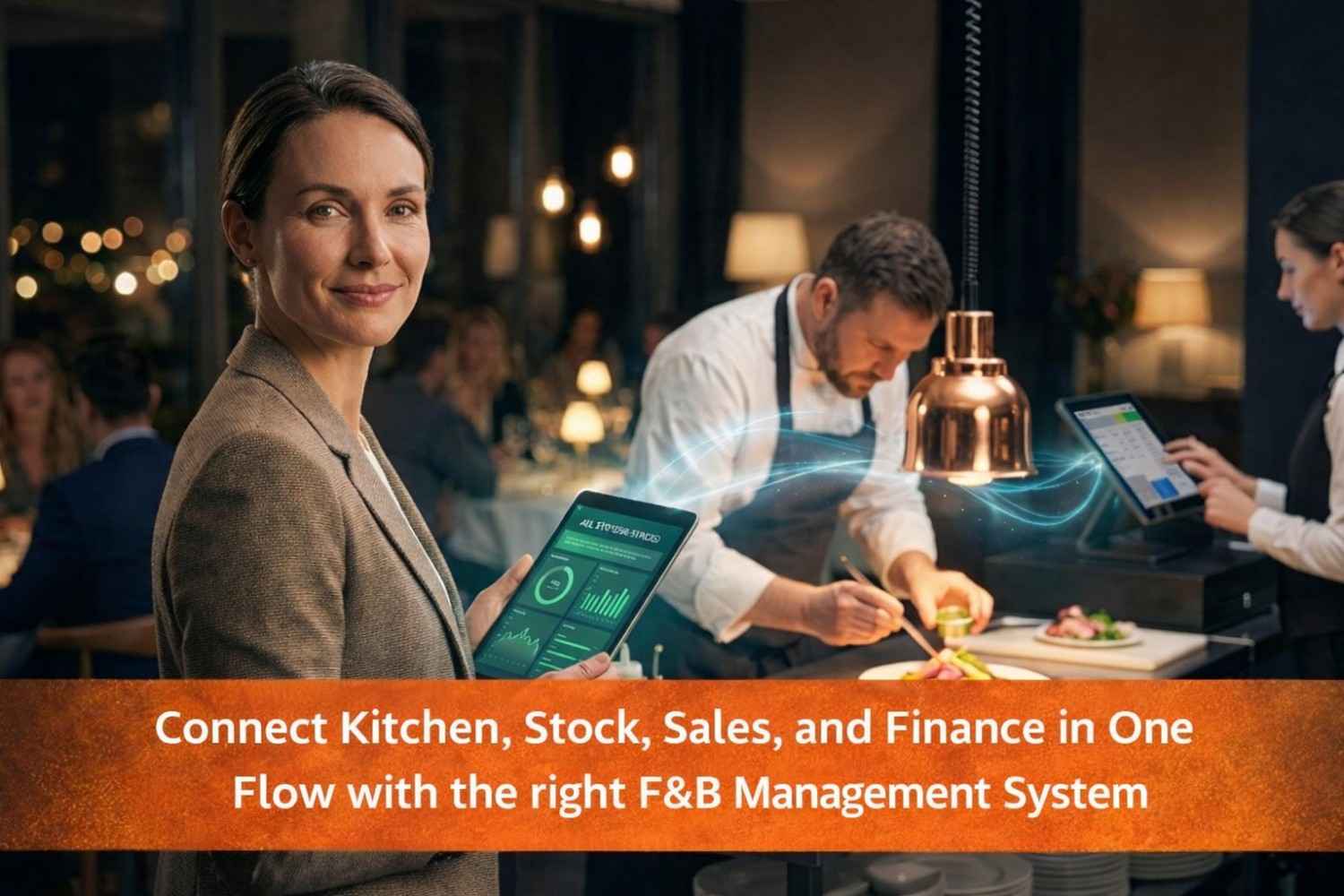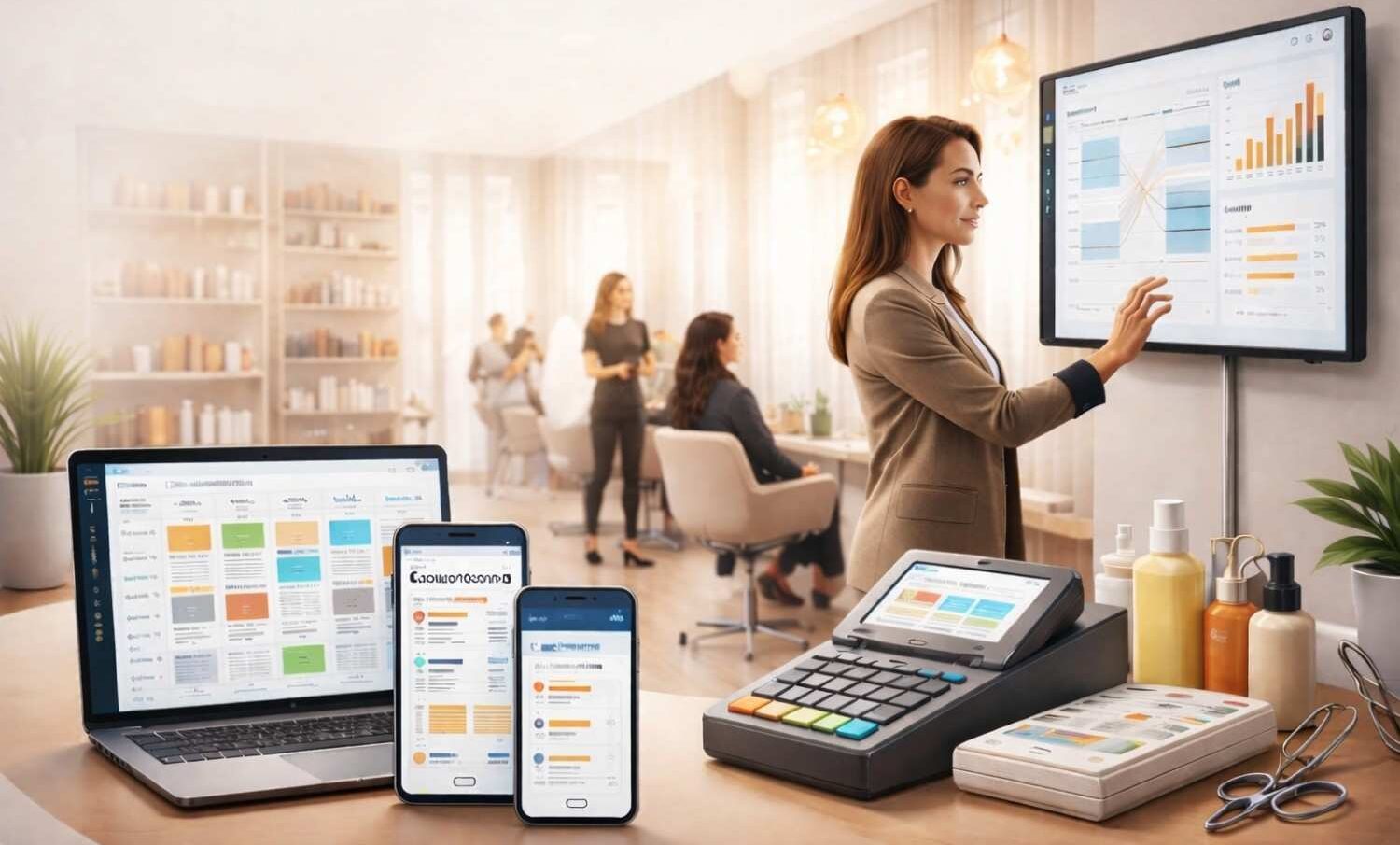
Running a restaurant today is not just about food and service. It is about speed, accuracy, and complete operational control.
Why Restaurant ERP Matters
From managing orders and inventory to handling staff and finances, restaurants deal with multiple moving parts every day.
Problems with Disconnected Systems
Key Statistics
40%
of restaurants still manually transfer data between systems
2.8%
median before-tax profit margin for full-service restaurants
76%
of operators believe technology gives competitive advantage
– Source – MarketMan
What is a Restaurant Management System?
A restaurant ERP software is a complete system that connects: POS (billing and order management), Inventory and stock tracking, Kitchen operations, Customer management, and Finance and reporting. Unlike standalone tools, an ERP brings everything into one connected platform.
Restaurants across Bahrain and GCC are rapidly adopting ERP systems due to growth of multi-branch restaurants and franchises, increase in online orders and delivery platforms, and the need for real-time visibility across operations.
Why Restaurants in Bahrain & GCC are moving to ERP
Restaurants across Bahrain and GCC are rapidly adopting ERP systems due to:
- Growth of multi-branch restaurants and franchises
- Increase in online orders and delivery platforms
- Need for real-time visibility across operations
Without a centralized system, managing multiple channels becomes difficult and inefficient.
10 Must-Have Features in a Restaurant ERP Software
Choosing the right restaurant management solution is not about having more features. It is about having the right features that solve real restaurant problems.
1. Integrated POS & Table Management
Fast and accurate billing, Table tracking and order management, Seamless coordination between staff.
👉 Helps reduce service delays and
improve customer experience
2. Kitchen Order Management System (KOT/KDS)
Orders sent directly from POS to kitchen, Eliminates manual errors, Improves kitchen workflow.
👉 Ensures faster preparation and accurate order delivery
3. Advanced Inventory & Stock Management
Real-time ingredient tracking, Automatic stock deduction, Alerts for low stock and wastage
👉Helps control food costs and reduce losses
4. Online Ordering & Delivery Integration
Integrates platforms like Zomato, Talabat, Uber Eats, Centralizes all orders in one system, Eliminates manual entry errors
👉 Ensures smooth handling of high order volumes
5. Customer Management & Loyalty Programs
Stores customer data and preferences, Loyalty points, offers, promotions, Encourages repeat visits
👉Improves customer retention and lifetime value
6. Real-Time Reporting & Analytics Dashboard
Track sales, costs, and performance, Identify best-selling items, Monitor daily operations
👉 Enables better decision-making using real data
7. Accounting & Financial Management
Automated billing and tax calculations, Profit and loss tracking, Financial reporting
👉Ensures accuracy and compliance in financial operations
8. Employee & Staff Management
Shift scheduling and attendance tracking, Payroll management, Performance monitoring
👉 Helps control labor costs and improve efficiency
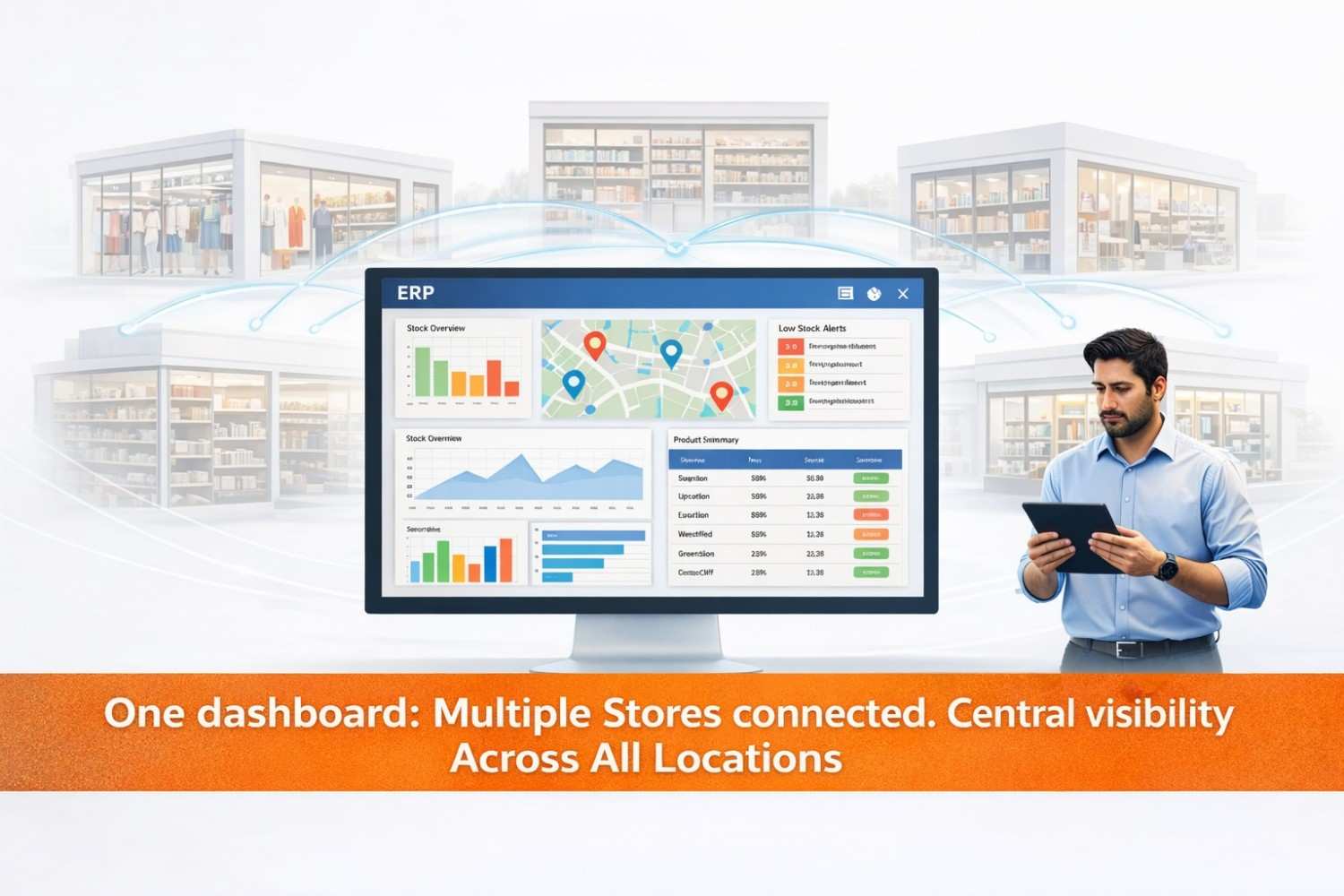
9. Multi-Location & Centralized Control
Manage multiple branches from one system, Centralized menu and pricing control, Consolidated reporting
👉Essential for scaling restaurant businesses
10. Mobile Access & Cloud-Based System
Access business data anytime, anywhere, Real-time updates across locations, Remote monitoring and control
👉 Enables faster decisions and better flexibility
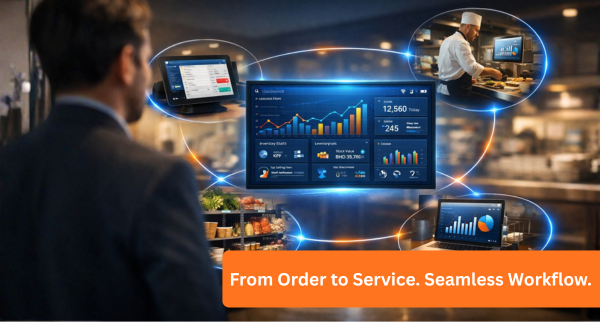
How These Features Work Together in Real Restaurant Operations
From order to kitchen to inventory to finance
A Connected ERP System Creates a
Smooth Workflow
👉 Every step is connected. No manual intervention.
❌ Without ERP (Busy Peak Hours)
- Orders delayed
- Kitchen confusion
- Stock shortages
- Billing errors
✅ With ERP (Busy Peak Hours)
- Orders flow instantly
- Kitchen works in sync
- Inventory updates automatically
- Billing is accurate and fast
Why an ERP System Is Better Than a Standalone POS
Limitations of POS-Only Systems
✕ No backend integration
✕ Manual inventory tracking
✕ Limited reporting
✕ No financial visibility
Benefits of ERP-Based Management
✓ End-to-end visibility
✓ Automation across operations
✓ Better control over costs and performance
✓ Scalable for growth
Key Takeaway
ERP transforms how your restaurant operates, not just how you bill. It’s a complete business management solution.
How to Choose the Right Restaurant ERP Software
Key Evaluation Checklist
- Easy to use for staff
- Supports integrations (POS, delivery, accounting)
- Scalable for future growth
- Offers real-time reporting
Questions to Ask Before Choosing
- Does it support multi-branch operations?
- Can it integrate with delivery platforms?
- Does it provide real-time insights?
- Is it suitable for GCC tax and compliance?
👉 Choosing the right system impacts your long-term growth. Take time to evaluate your specific needs.
Ready to Simplify Your Restaurant Operations?
If your restaurant is still running on multiple disconnected systems, it is time to rethink your approach. A modern restaurant ERP software helps you connect all operations in one system, reduce errors and manual work, gain real-time visibility, and scale your business with confidence.
Book a Free Consultation
Talk to our ERP experts to understand how you can:
✔ Streamline your restaurant operations
✔ Improve efficiency and profitability
✔ Implement the right system for your business
+973 1717 8000 (Bahrain) – Also Serving GCC
Frequently Asked Questions
Find answers to common questions about restaurant ERP systems
What is the difference between a restaurant POS and a restaurant ERP?
- POS handles billing and orders
- ERP manages the entire business (POS, inventory, finance, CRM)
👉 POS = transactions. ERP = full operations
Can a POS system alone manage my restaurant operations?
A POS system handles billing and orders but does not manage inventory, finance, or reporting fully. You still need multiple tools to run your restaurant efficiently.
I already use separate tools for billing, inventory, and accounting. Why is that a problem?
Using separate tools leads to data mismatch, manual work, and no real-time insights. This results in errors and delays that impact your business operations.
How does restaurant ERP software help reduce food waste?
ERP tracks stock in real-time, auto-updates inventory, and alerts for low or expiring items. This reduces overstocking and wastage significantly.
Can restaurant ERP integrate with Talabat, Zomato, and Uber Eats?
Yes, modern ERP systems sync all orders from these platforms in one system and send orders directly to the kitchen. This enables faster processing and fewer errors.
How does an ERP help manage multiple restaurant branches?
ERP provides a central dashboard, unified menu and pricing across locations, and consolidated reports. You get full control across all your locations.
How difficult is it to switch from a standalone POS to an ERP?
For small setups it takes a few days, while multi-branch operations may take a few weeks. The transition is easier with the right implementation partner.
Is a restaurant ERP worth the investment for a small restaurant?
Yes, ERP reduces errors, improves control, and supports growth. It helps small restaurants scale efficiently without operational chaos.