The Overselling Problem in Fashion Retail
A customer orders a trending dress online.
Minutes earlier, the same size sold out at a physical store.
The website still shows “In Stock.”
The order goes through.
A cancellation email follows the next day.
This is overselling. And in fashion retail, it happens more often than businesses admit.
Overselling creates:
- Refunds and payment reversals
- Customer support overload
- Negative reviews
- Reduced repeat purchases
- Margin leakage
Fashion retail is especially vulnerable because of:
- High SKU variability: style, size, and color combinations
- Fast-moving collections and promotions
- Multi-store inventory spread across locations
When stock updates are delayed even by 30 to 60 minutes, the risk multiplies. Overselling is not just an inventory issue. It becomes a brand trust issue.
The fix is not more spreadsheets or manual cross-checks. The fix is proper ERP ecommerce integration.
When your ERP system becomes the single source of truth for inventory across:
- POS
- Warehouse
- Ecommerce
- Marketplaces
- Stock updates in near real time
- Variant-level accuracy improves
- Overselling stops
Hornet enables this by integrating and configuring ERP systems to work seamlessly with ecommerce platforms and retail operations.
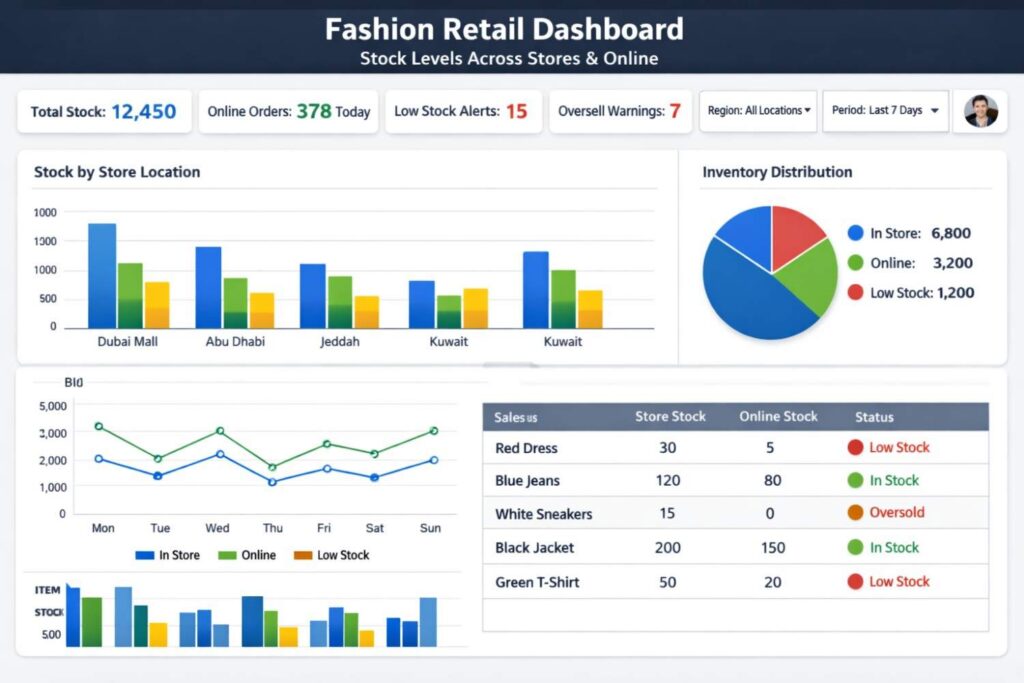
Why Fashion Retail Is More Vulnerable to Overselling
Fashion businesses manage:
- Matrix inventory: Style × size × color
- Seasonal demand spikes
- Flash promotions
- Multi-location stores
- Returns and exchanges
A single T-shirt style can have:
- 5 sizes
- 4 colors
- Multiple store locations
That creates dozens of inventory combinations for one product.
If systems are not connected, it can easily lead to the selling of:
- The wrong size
- The wrong color
- Stock that no longer exists
This is where structured ERP integration becomes critical.
Hornet works as an ERP integration partner, enabling fashion retailers to implement systems that support multi-dimensional product attributes such as size and color. This ensures accurate variant-level inventory tracking across stores, warehouses, and ecommerce channels.
What Causes Overselling in Fashion Retail
- Tab 1
- Tab 2
- Tab 3
Stage 2: Planning and Resource Allocation
Once a quotation is approved: it converts into a structured project, tasks and milestones defined, teams assigned, inventory reserved, budgets locked. No duplicate entry. No manual transfers.
For multi-branch retailers and distributors, POSibolt supports centralized stock visibility across warehouses and stores.
Governance research further confirms that ERP projects benefit from multi-level oversight structures that reduce delays and rework through structured approvals. (Anees Ara & Al-Mudimigh 2011)
Stage 3: Execution and Real-Time Tracking
Timesheets / material consumption dashboard
During execution: Timesheets link directly to tasks, material consumption posts against the job, expenses reflect in budget dashboards, cost vs plan is visible immediately. Manufacturers benefit from BOM-driven production integration. Retailers benefit from synchronized stock updates across branches.
Instead of discovering losses after completion, management sees project health in real time.
Stage 4: Invoicing and Closeout
Cash flow discipline is essential in GCC markets. ERP enables: milestone-based invoice triggers, percentage-of-completion billing, retention tracking, project-wise P&L reports. Automation accelerates cash cycles while maintaining compliance.
At closeout: estimated vs actual comparison improves future quotes, margin analysis strengthens pricing strategy, data-driven learning reduces repeat mistakes.
Stop margin leakage. Start lifecycle control.
Discover how Hornet ERP connects quotation to completion in one platform.
Bahrain & GCC — tailored for SMEs
Key ERP Features That Enable Lifecycle Control
Modern ERP systems support real-world operational control: real-time dashboards, automated reorders, approval hierarchies, multi-branch visibility, mobile apps, integrated project-wise profitability.
- Inventory Tracking
- Project Dashboards
- Quotation Tools
- Expiry alerts, multi-store sync
- Store profitability visibility
- Promotion integration
- BOM, lot tracking
- Job cost variance
- Accurate material costing
Real-World Performance Impact
Implementation Without Disruption
Research consistently confirms that lack of structured project management is one of the leading causes of ERP underperformance. Implementation must follow a structured path:
Hornet’s approach focuses on: business-first consultation, customized configuration, controlled rollout, post-go-live support. For SMEs, typical timelines range from 3–6 months depending on scope. Cloud deployment reduces infrastructure burden and upfront cost.
When Should You Consider Lifecycle ERP?
- ▶ Multiple projects run simultaneously
- ▶ Inventory gaps delay execution
- ▶ Invoice cycles are inconsistent
- ▶ Profitability is unclear until month end
- ▶ Expansion across Bahrain or GCC is planned
- ▶ Management relies heavily on Excel for reporting
Growth without structure increases risk exposure.
FAQs
How does ERP reduce quotation errors?
Is ERP suitable for retail or manufacturing?
What about cost and timeline?
Conclusion
Project profitability does not depend only on winning contracts. It depends on controlling the lifecycle from quotation to completion.
Disconnected systems create: delays, overruns, margin erosion. Integrated ERP creates: structured governance, real-time visibility, faster billing, predictable profitability.
For growing project-based businesses in Bahrain and across the GCC, lifecycle ERP is not a technology upgrade. It is an operational control framework.
Ready to connect your quotation to completion?
Get a personalized demo for your SME. 3–6 month implementation, cloud or on‑premise.
+973 1717 8000 (Bahrain) – Serving GCC