Furniture is a fast-moving business now. Customers want more choice, quicker delivery, cleaner finishes, and better service.
At the same time, the industry is getting bigger and more competitive. Grand View Research estimates the global furniture market generated about USD 677.1 billion in 2022 and forecasts it to reach about USD 1.07 trillion by 2030.
So what breaks first when a furniture business grows?
Usually it is not sales. It is the gap between production, warehouse, showroom, and accounts.
This blog explains how an ERP connects those moving parts, and why that connection is what protects profit.
Why furniture operations get messy faster than other industries
If you run a furniture business, you already know this. Your products look simple from the outside, but they are operationally complex.
Here are the furniture-specific realities that generic systems struggle to handle.
-
Custom orders
-
Units of Measure
-
Waste & Rework
Custom orders create "variant overload"
A single sofa can branch into dozens of combinations: size, arm style, cushion type, legs, foam density, fabric choice, fabric batch differences, piping, stitching style, two-tone combinations, cushion fabric different from body fabric. If every combination becomes a separate SKU, your catalogue becomes unmanageable. If you do not control variants properly, wrong items get built or delivered.
Wood and fabric are not "one unit of measure"
Wood can be measured by length, area, volume, or pieces. Fabric can be managed by rolls, meters, and batches. Hardware is counted by pieces. Consumables like staples, thread, glue are used in bulk. Without a system that supports these realities, your BOM, costing, and inventory accuracy will always be shaky.
Waste is real, and it directly affects margins
Furniture manufacturing has "invisible costs": off-cuts that cannot be reused, wood defects that force extra consumption, fabric shade variation that causes rework or rejection, rework due to design revisions or wrong configurations. If you cannot track waste and rework properly, you will keep selling "profitable" products that quietly lose money.
Your sales side is not one address, one location
Furniture businesses often operate with: showrooms in one location, warehouse in another, factory in another, delivery sites that change per job. When these are not connected, promises made in the showroom do not match reality on the shop floor.
The hidden cost of disconnected systems
Most furniture teams do not wake up and choose chaos. It happens gradually. Here is what usually shows up first when systems are disconnected.
- Production delays because materials were not planned early enough.
- Stockouts in showrooms because warehouse stock is not visible in real time.
- Overstock of slow-moving designs because purchases are not tied to demand.
- Margin leakage because approvals and discounts are not controlled.
- Customer frustration because delivery dates shift repeatedly.
- Finance confusion because invoices, GRNs, and payments do not reconcile cleanly.
What "Furniture Industry ERP" actually means
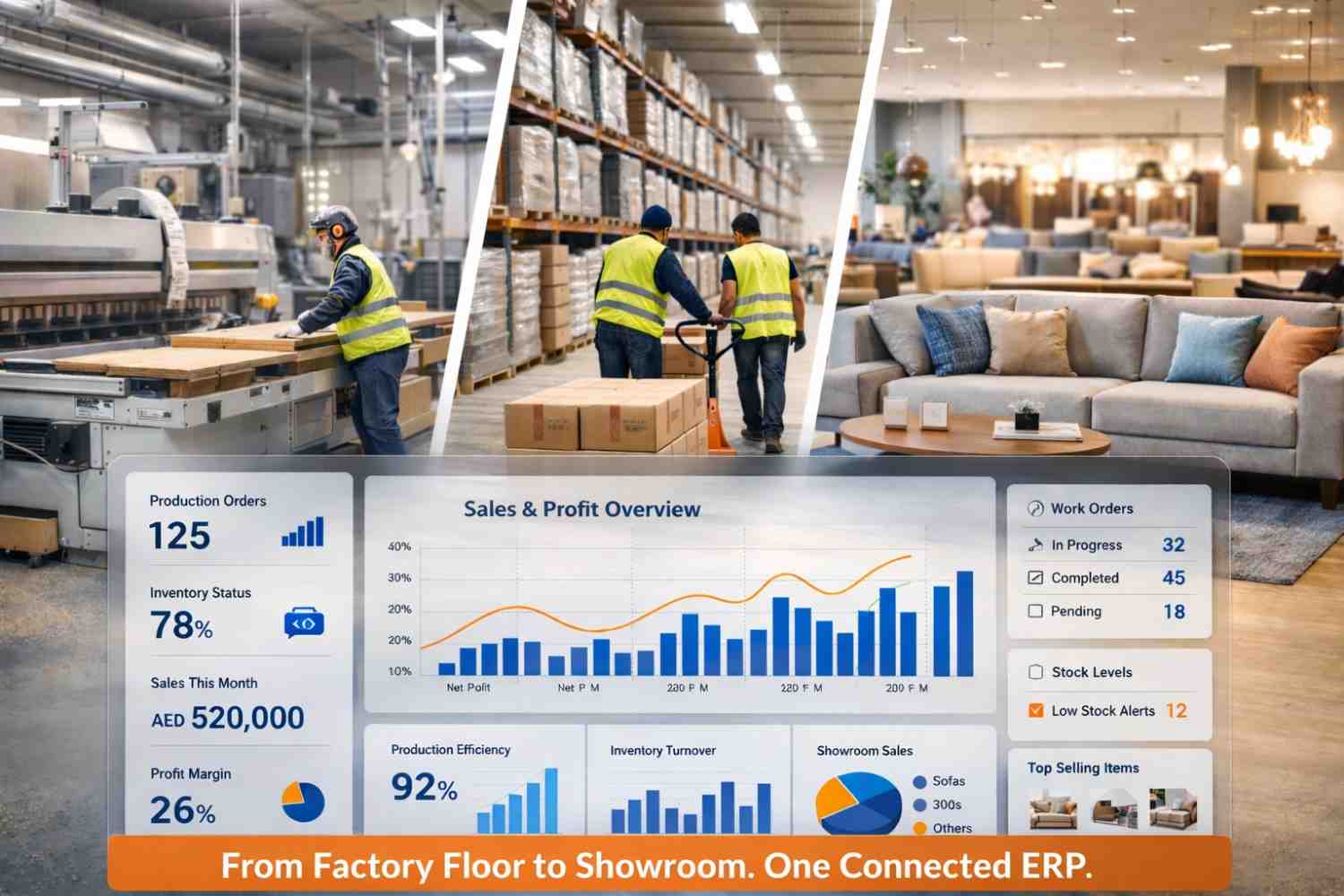
A furniture ERP is not just accounting plus inventory. It is a connected operating system that links:
- Product and variant data.
- Bills of materials and routing.
- Raw material and finished goods inventory.
- Production planning and work orders.
- Warehouse movement and transfers.
- Showroom sales and delivery commitments.
- Finance, costing, and profitability reporting.
If you want a quick overview of what an integrated ERP covers across departments, check the ERP solutions page.
Connect your furniture business from workshop to showroom
Real-time stock · variant control · waste tracking · margin visibility
How ERP connects production, showrooms, and profits
Real-world example: what "connected" looks like in one order
Imagine 3-seater sofa with a specific fabric and cushion variant. In a connected ERP flow:
- The showroom confirms configuration and delivery timeline based on available capacity.
- The system checks fabric stock and planned arrivals.
- A production order is created with the correct BOM and operations.
- Purchasing gets an alert if fabric needs replenishment.
- Work-in-progress updates are visible to sales, so customer updates are accurate.
- Dispatch happens with proper picking. Invoice and posting happen without manual re-entry.
- Profitability is visible per order, including waste and rework.
This is not “automation for the sake of it.” It is fewer handoffs and fewer mistakes.
What to look for when choosing a furniture ERP
This checklist is written for owners, operations heads, and finance managers who want clarity before a demo.
Must-have capabilities for furniture businesses
- ✓ Variant configuration support for custom orders.
- ✓ BOM and routing that can adapt to options and revisions.
- ✓ Multi-unit material handling for wood, fabric, hardware.
- ✓ Waste and rework tracking.
- ✓ Multi-warehouse and multi-branch stock visibility.
- ✓ Integrated showroom POS and returns handling.
- ✓ Order-to-cash flow visibility, including delivery commitments.
- ✓ Role-based approvals for discounts and changes.
- ✓ Dashboards for production status, inventory movement, and margin.
- ✓ Strong implementation support, training, and process mapping.
One thing to avoid when implementing ERP in furniture
Furniture businesses differ in product mix, customisation depth, production method, branch model, delivery model. If you do not map your real process first, your ERP becomes “yet another system people work around.”
A better approach is simple:
- Document current flow. Sales to production to dispatch to finance.
- Identify where delays and errors happen today.
- Implement ERP modules in phases, starting with the biggest leakage points.
FAQs
Is ERP only for large furniture manufacturers?
No. ERP becomes useful as soon as you face coordination problems between teams, branches, or warehouses. Many SMEs adopt ERP when they move beyond a single location and a small catalogue.
Can ERP handle both manufacturing and showroom retail?
Yes, if it is designed as one connected system. You should be able to see the same product, stock, pricing rules, and customer history across the factory, warehouse, and showroom.
How does ERP help with inventory in furniture showrooms?
It improves inventory by giving real-time visibility and better replenishment planning. It also highlights slow-moving stock and stock aging, which is important for seasonal demand.
What is the biggest ROI driver for furniture ERP?
In most furniture businesses, ROI comes from a mix of: reduced waste and rework, fewer delayed deliveries, lower dead stock and holding cost, better margin control and approval workflows, faster, cleaner financial closing.
Closing takeaway
Furniture businesses do not lose money only because of high costs. They lose money because teams work with different versions of the truth.
When ERP connects production, showroom selling, warehousing, and finance:
- Delivery promises become reliable.
- Inventory becomes predictable.
- Waste becomes visible.
- Profits stop leaking silently.
If you want to explore what a connected ERP setup could look like for your furniture business, start with a process-first consultation.
Ready to connect production, showrooms, and profits?
www.hornettec.com
+973 3422 1784 | +973 35047257