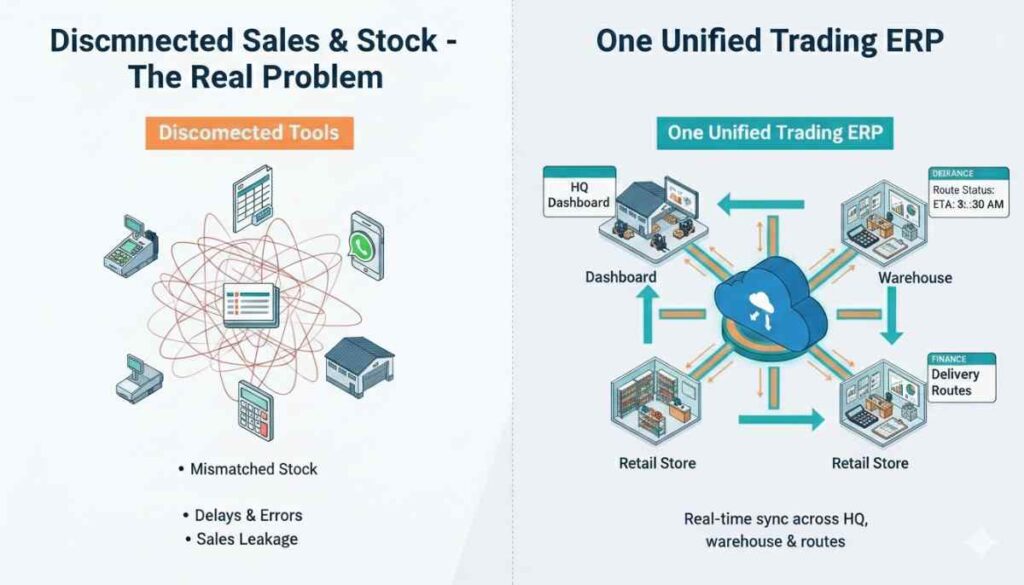
Ever had your van-sales team promise a delivery that “the system” says exists – but the warehouse can’t find? Or a purchase team reordering because spreadsheets weren’t updated after last-mile returns? That’s the cost of disconnected tools.
Trading and distribution businesses often run on islands – POS here, spreadsheets there, accounting elsewhere, and van-sales tracking on phones. The result? Inventory mismatches, delayed dispatches, slow reconciliations, and invisible leakages that eat margins.
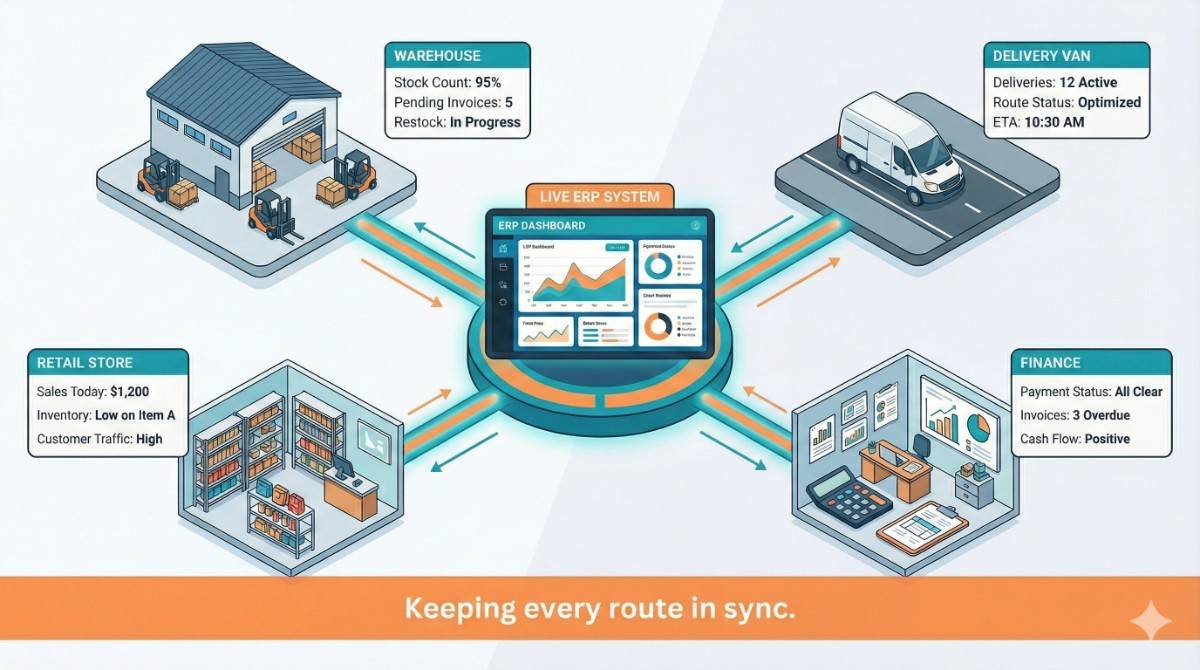
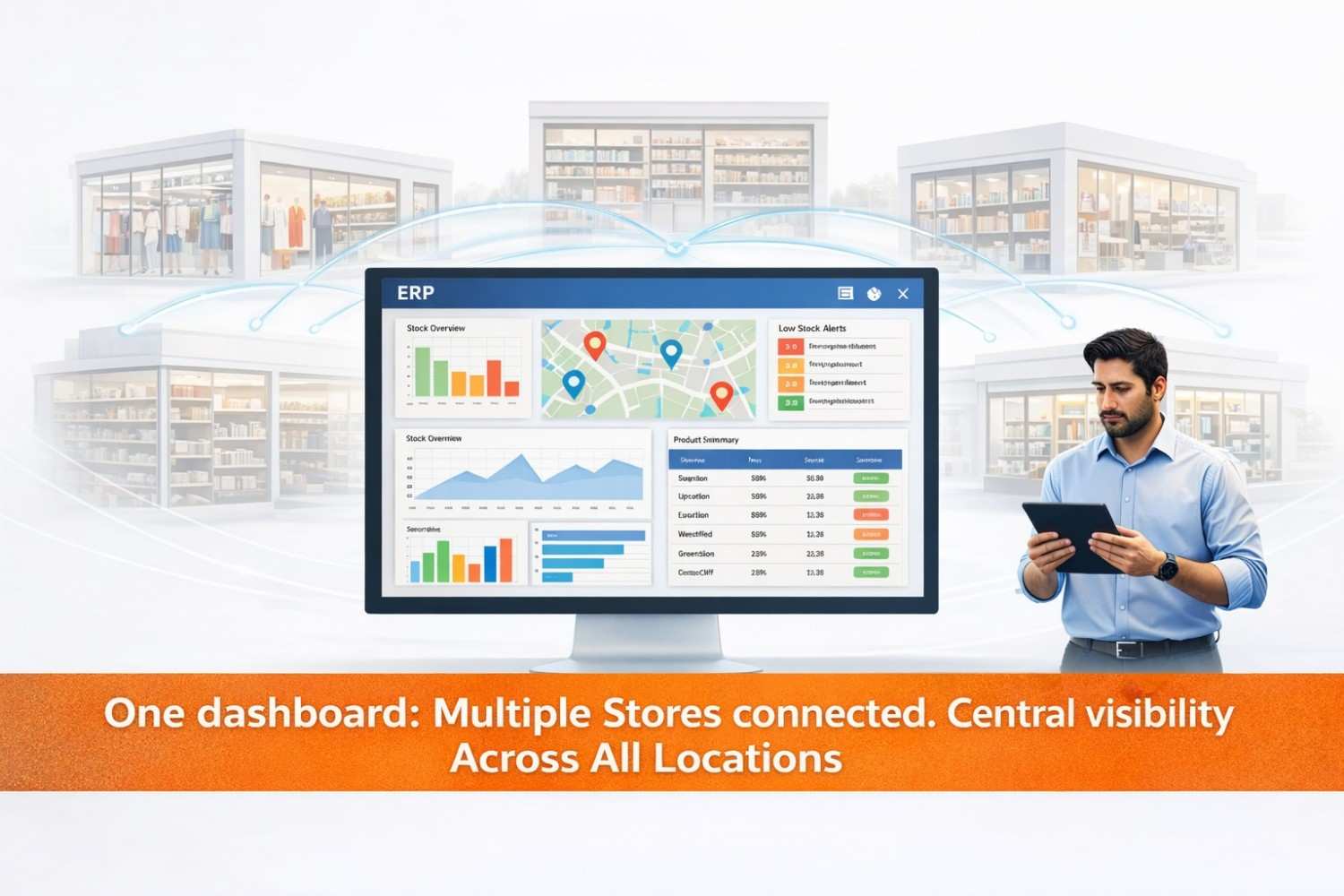
Imagine one connected backbone where sales orders reserve stock instantly, route vans sync live, landed cost flows into item costing, and finance closes faster because every step is already reconciled.
That’s exactly what Hornet’s Trading ERP does: a unified platform that keeps HQ, warehouses, and every route in lockstep, even when connectivity is flaky. (Yes, a van sales system that auto-sync to HQ when back online is built-in.)
What is a Trading & Distribution ERP?
A trading ERP is the central nervous system for distributors, importers, and general traders.
It consolidates inventory, purchase, sales, logistics, and finance into one real-time database.
Think: one order → reserves stock → triggers fulfillment → posts accounting entries → updates dashboards.
Not another app in your stack. The system of record that everything else plugs into.
What this looks like in practice:
- Unified data model so sales, inventory, and finance speak the same language.
- Real-time visibility across warehouses, vans, and stores.
- Role-based workflows and approvals from PO → GRN → invoice → payment.
- Offline-first field/van sales that sync back to cloud for HQ control.
Challenges Faced by the Trading Industry
Trading is a coordination game. One that depends on real-time visibility, accuracy, and communication across multiple moving parts.
Here are some of the most common pain points that hold businesses back:
1. Stock visibility gaps
Many trading companies struggle with mismatched inventory data between “on hand,” “in transit,” and “reserved” quantities.
This lack of visibility leads to frequent stockouts, excess stock, and capital stuck in slow-moving items that rarely sell.
2. Manual order-to-cash cycles
Relying on emails and spreadsheets for order confirmations, approvals, and invoicing often creates delays and duplicate entries.
Manual processes reduce accuracy, slow down cash collection, and make it difficult for teams to stay on the same page.
3. Landed cost complexity
Freight, customs duties, insurance, and handling charges are often recorded separately or inconsistently.
When these costs aren’t properly allocated to product pricing, the business loses visibility into actual profit margins and makes poor pricing decisions.
4. Multi-location chaos
Operating with different systems for warehouses, vans, and retail counters leads to inconsistent pricing, duplicate records, and uncoordinated stock transfers.
Without a centralized system, businesses find it nearly impossible to track what’s happening across all branches in real time.
5. Compliance and audit trail issues
Scattered documents and manual reconciliations make it difficult to maintain a proper audit trail.
Missing data, unlinked invoices, and manual reporting increase the risk of compliance errors and consume valuable time during audits.
6. Disconnected route operations
Many trading and distribution companies run their van or field sales offline.
Without real-time synchronization, HQ teams can’t track cash collections, returns, or stock levels accurately, resulting in delayed updates, reconciliation gaps, and missed revenue insights.
ERP for Specific Trading Verticals
Each segment has unique wrinkles. Here’s how a trading ERP adapts:
📉 Commodity Trading
⚠️ Pain Points
- Volatile prices and FX
- Complex landed costs
- Contract-based buying/selling
✅ ERP Fit
- Contract-to-invoice traceability
- Multi-currency support
- Landed cost allocation into item cost
- Margin by deal/batch
🌾 Agro Commodity Trading
⚠️ Pain Points
- Seasonality
- Quality grades
- Batch/lot traceability
✅ ERP Fit
- Batch/lot + expiry tracking
- Quality checks at GRN
- Re-order logic that respects grade and shelf life
🌍 ExIm & International Trade
⚠️ Pain Points
- Incoterms
- Customs procedures
- Documentation requirements
- Multi-currency settlements
✅ ERP Fit
- Shipment workflows
- Landed cost by weight/volume/value
- Multi-currency ledgers
- PDC alerts and bank reconciliation
⚙️ Heavy Equipment & General Trade
⚠️ Pain Points
- Serialised items
- Warranty management
- Service/AMCs
✅ ERP Fit
- Serial/asset management
- Service tickets
- Warranty rules
- Integrated service billing
🏭 Steel Trading
⚠️ Pain Points
- Length/weight conversions
- Heat/batch traceability
- Variable pricing
✅ ERP Fit
- Attributes (thickness, grade)
- Dynamic UoM conversions
- Batch costing
- Multi-level price lists
⛏️ Coal Trading & Import
⚠️ Pain Points
- Moisture/quality adjustments
- Freight-heavy landed cost
- Port/yard movements
✅ ERP Fit
- Quality factors in costing
- Freight contracts
- Yard → warehouse transfers
- In-transit visibility
Core Capabilities of a Trading ERP
Inventory Management
- Real-time stock across locations with batch/serial and expiry tracking.
- Slow/fast-moving analysis with ROL and min-max controls.
- PDA/mobile-enabled stock take for accurate physical verification.
- Visibility of on-order, on-hand, reserved, and in-transit stock to prevent accidental stockouts.
Purchase Order Management
- Requisition → RFQ → PO → GRN with QC → Supplier bill, all supported with approvals.
- Automated reorders based on consumption trends and supplier lead times.
- Accurate landed cost rolled into item cost for true margin visibility.
Sales Order Management
- Quote → SO → pick/pack/ship → invoice → collection with credit control, multi-price lists, promotions/discount rules, and van/route sales baked in.
- Route sales app for order → invoice on the spot, returns, and cash collection, even offline.
Financial Management
- Multi-company/currency, AR/AP, PDCs, cash/bank, tax filings, and GL that posts as operations happen (not weeks later)
- P&L, Balance Sheet, Trial Balance, and profitability by item/customer/branch.
Budget Management
- Plan and track trade funds, visibility of actuals vs. budgets, and spend controls at each approval step.
Supplier Management
- Scorecards (lead time, quality, price trends), contract quantities, and open commitments in one view.
- Vendor portal or streamlined communications for faster cycle times.
Return Management
- Reverse logistics, inspection, and credit-note workflows for clean books and accurate inventory.
Freight Management
- Freight contracts, accruals, and allocation to item cost; in-transit tracking with yard/port nodes.
Benefits of Trading & Distribution ERP
-
One source of truth
With all departments working on a unified platform, duplicate data entries are eliminated,
reconciliations become effortless, and management can make faster, more confident decisions
using accurate, real-time information.
-
Lower working capital
Smart, automated reordering combined with real-time visibility into stock levels helps
businesses maintain optimal inventory, reducing excess stock while preventing stockouts
that disrupt sales.
-
Reliable margins
By accurately calculating landed costs and applying precise costing methods such as FIFO
or weighted average, the ERP system ensures that every item’s profitability is transparent
and reliable.
-
Faster order-to-invoice cycle
Automated approval workflows and seamless synchronization between headquarters and route
sales teams significantly shorten the time taken from receiving an order to generating an
invoice.
-
Audit-ready operations
Every transaction, document, and approval is securely logged, creating a complete audit
trail and generating compliance-ready reports at the click of a button.
-
Centralized multi-location control
Policies, pricing structures, and promotional campaigns can be configured once at the head
office and automatically applied across all branches and sales points, ensuring consistency
and control across the organization.
Challenges in Implementing ERP for Trading (And How to Avoid Them)
-
Resistance to change
Employees may hesitate to adopt a new system due to unfamiliar workflows.
Involving key users early, running live-data pilots, and offering role-based training
can help build confidence and ease the transition.
-
Integration hurdles
Connecting ERP with existing tools like banking, e-commerce, warehouse, or tax systems
can be tricky. The best approach is to map current integrations carefully and use stable,
well-supported APIs to ensure seamless data flow.
-
Data migration quality
Poorly maintained data from legacy systems often leads to issues after go-live.
Cleaning up master data such as items, customers, vendors, and opening balances beforehand
ensures a smooth start.
-
Customization creep
Over-customizing the system can delay implementation and complicate maintenance.
Start with standard modules that fit 80% of your needs and add only essential
customizations in later phases.
-
Downtime anxiety
Businesses fear disruption during rollout, especially in trading environments that run
daily operations. Piloting the ERP in one branch or route first, then gradually expanding,
minimizes downtime and builds user trust.
-
Post-go-live dip
Teams may face a short adjustment period after launch, affecting productivity.
Continuous on-floor support and short refresher training sessions help users adapt quickly
and regain full efficiency.
Hornet ERP for Trading: How We Do It (Process You Can Trust)
Output:
- A comprehensive solution blueprint with process maps
- KPIs to track from day one
- Clear implementation roadmap
Output:
- Tailored ERP system with no bloat or unnecessary features
- Streamlined UI with only relevant fields
- Custom reports for your specific business needs
Output:
- Seamless integration with existing systems
- Clean data migration
- Pilot implementation with a single branch/route
- Organization-wide rollout playbook
Output:
- Hypercare support immediately after go-live
- Ongoing support with regular updates
- Advanced dashboards for deeper insights
- Quarterly training refreshers