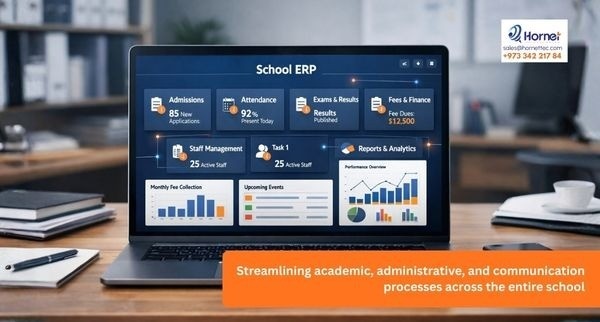
Why Schools Need to Digitize Now
Schools today manage far more than classrooms and exams. Admissions, attendance, academics, fees, payroll, compliance, communication, and reporting all run in parallel. When these functions operate on separate tools or manual processes, complexity increases and visibility reduces.
This is where Enterprise Resource Planning (ERP) systems play a critical role. A school ERP brings academic and administrative workflows into a single digital platform, helping institutions operate with clarity, accuracy, and consistency.
The Digital Transformation Imperative
As schools grow in student strength, programs, and expectations, manual processes struggle to keep up. Most institutions face similar operational challenges that can be effectively addressed through digital transformation.
Challenges with Manual and Disconnected Systems
Fragmented systems create significant inefficiencies that drain resources and reduce educational focus. Here are the most common challenges schools face:
Fragmented Operations
Vital functions like admissions, attendance, grades, and fee collection are handled by a patchwork of different tools, spreadsheets, emails, or physical files.
Repetitive Data Entry
Staff spend excessive time on manual data entry, reconciling conflicting information, and chasing approvals across departments.
Lack of Real-time Visibility
Difficulty in obtaining an up-to-date overview of the school's overall health, performance metrics, and operational status.
Errors and Compliance Issues
The volume of paperwork increases the likelihood of errors and compliance problems with regulatory requirements.
What Is a School ERP System?
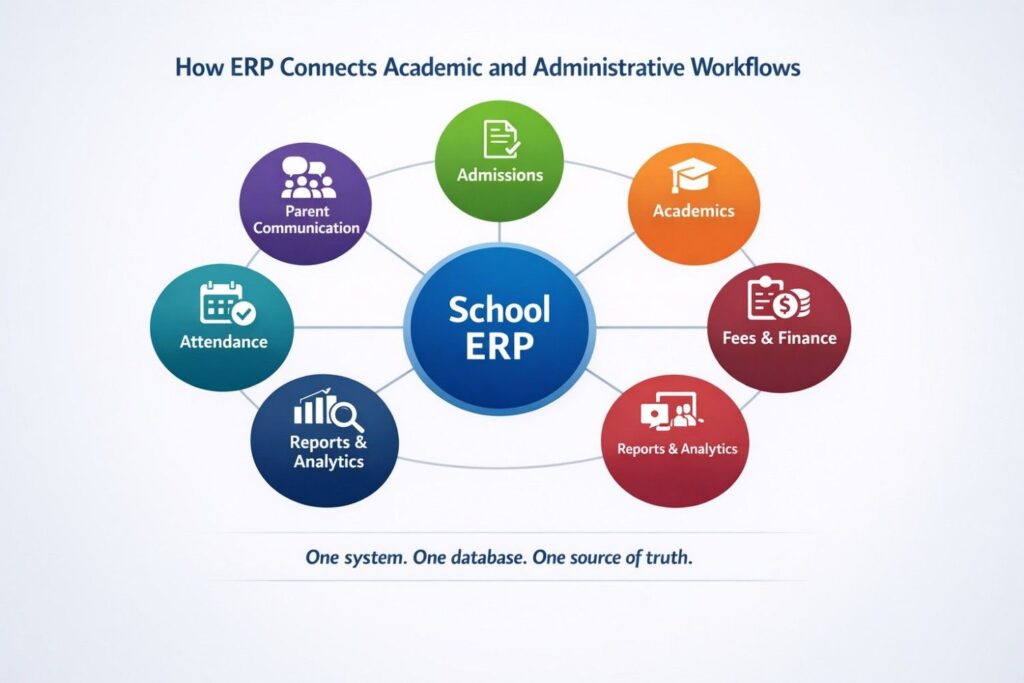
A school ERP system is a centralized digital platform that integrates academic and administrative functions into one system. Instead of departments working in isolation, ERP allows:
- ✓Shared, real-time access to data across all departments
- ✓Role-based visibility for teachers, administrators, finance teams, and management
- ✓Automated workflows for repetitive tasks like attendance tracking and fee collection
- ✓Reduced errors, consistent data, and smoother coordination across the institution
The result is a unified system that breaks down information silos and creates a single source of truth for the entire institution.
How ERP Transforms School Operations
ERP systems address both academic and administrative workflows, creating efficiencies across the entire institution. A structured ERP consulting and implementation approach helps schools assess current workflows, avoid misalignment, and ensure smoother adoption across academic and administrative teams.
Simplifying Academic Operations
Academic operations form the core of any school. ERP systems simplify these workflows without increasing workload for teachers.
Key Academic Features:
- ✓ Student Information & Academic Records: Each student has a single digital profile with connected admissions data, attendance, grades, and academic history
- ✓ Attendance & Timetable Management: Digital attendance recording with apps, biometric systems, or GPS-enabled tools
- ✓ Examination & Performance Tracking: Digital exam management, grading, and result processing with faster report card generation
- ✓ Historical Performance Data: Track student progress over time with comprehensive analytics
Streamlining Administrative Processes
Administrative processes often consume the most time and resources. ERP systems help reduce this burden significantly.
Key Administrative Features:
- ✓ Admissions & Enrollment: Online applications, document submission, and central tracking of application status
- ✓ Fee Management & Financial Operations: Automated fee schedules, reminders, receipts, and integration with online payment systems
- ✓ HR, Payroll & Staff Management: Digital attendance and leave tracking for staff with reduced payroll errors
- ✓ Records, Compliance & Security: Secure digital storage of sensitive data with easier compliance reporting
Improving Communication & Collaboration
ERP systems improve communication by replacing fragmented channels with structured, secure platforms.
Communication Benefits:
- ✓ Unified Dashboards: Leadership gains real-time visibility into student performance, enrollment trends, and resource utilization
- ✓ No Conflicting Reports: Eliminates discrepancies between departmental reports with consistent data
- ✓ Parent Portals: Secure access for parents to monitor academic progress, attendance, and fee status
- ✓ Data-Driven Decision Making: Centralized ERP dashboards transform daily decision-making with real-time insights
Ready to Transform Your School's Operations?
Discover how Hornet’s ERP solution can streamline your academic and administrative workflows, reduce costs, and improve educational outcomes.
Benefits of Implementing ERP in Schools
Schools that implement ERP systems experience measurable improvements across multiple operational areas.
Lower Administrative Effort
Automating routine tasks allows staff to focus on strategic initiatives and core educational objectives rather than manual paperwork. Schools report up to 40% reduction in administrative time after ERP implementation.
Better Accuracy and Data Integrity
Centralization eliminates redundancy and reduces human error, ensuring consistent and reliable information across all departments. Single data entry points mean updates reflect everywhere immediately.
Cost Efficiency & Scalable Operations
Long-term savings from reduced manual labor, less paperwork, and optimized resource utilization can be substantial. The system can grow with the school's needs (e.g., increasing student numbers, new programs, additional campuses).
Increased Transparency & Improved Security
Parents can monitor their child's academic progress and attendance through secure portals, fostering home-school collaboration. Robust security features protect sensitive data and help schools comply with privacy regulations like FERPA and GDPR.
Who Should Consider a School ERP Now?
If your institution falls into any of these categories, implementing an ERP system should be a priority:
Growing Schools
Experiencing rapid growth in student enrollment or academic offerings that outpaces manual processes.
Multi-Branch Institutions
Minimized data entry errors and better medication management
Schools Facing Reporting Challenges
Struggling with generating accurate, timely reports or managing complex fee structures and financial operations.
Leaders Aiming for Data-Driven Decisions
Struggling with generating accurate, timely reports or managing complex fee structures and financial operations.
Final Thoughts: Digitization Is No Longer Optional for Schools
Digitizing schools is a necessity for efficiency, engagement, and sustainable growth in the evolving educational landscape. A well-implemented School ERP system provides structure, clarity, and long-term stability, moving beyond manual inefficiencies.
Your Next Steps
- ✓ Focus on Core Mission: ERP frees up educators and administrators to focus on fostering an exceptional learning environment
- ✓ Strategic Integration:
Creates a cohesive digital ecosystem benefiting students, staff, and parents
- ✓ Practical Implementation: Evaluating an ERP system with education-specific workflows is a practical step for schools planning digitizatio
- ✓ Expert Consultation: Speaking with an ERP consultant can help determine the appropriate level of digitization for your school’s needs.
Transform Your School with Hornet's Education ERP Solution
If your school is planning long-term growth or facing increasing operational complexity, exploring Hornet’s ERP integration solution for educational institutions can help align academic and administrative workflows into one stable, scalable system designed for efficient school management.