
Struggling with quotations that don’t match actual costs?
Facing stock shortages mid-project?
Waiting weeks to raise milestone invoices?
These are not isolated problems. They are lifecycle control gaps.
Across Bahrain and the GCC, many growing SMEs manage quotations, procurement, execution, and finance in separate systems. The result is predictable:
- ▸ Cost overruns
- ▸ Delayed billing
- ▸ Margin leakage
- ▸ Limited project visibility
Project Lifecycle Control
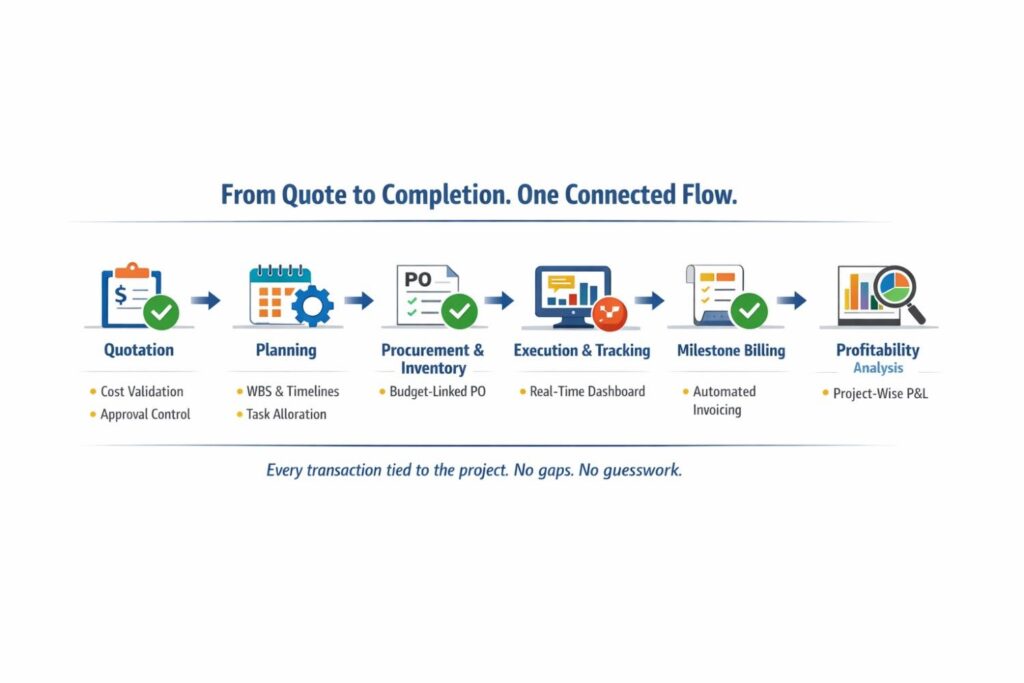
Illustration: unified workflow from quote to completion
Why Project Lifecycle Control Matters
Project businesses rarely struggle with demand. They struggle with coordination.
When quotations sit in spreadsheets, procurement happens through emails, site updates stay in chats, and accounting works independently, no one has a complete view of project performance.
Research supports this concern.
“ A peer-reviewed study published in Global Journal of Computer Science and Technology found that historically only around 30% of ERP implementations were considered successful, and structured project management was identified as a critical success factor.
This reinforces a key business principle:
ERP success depends on governance and lifecycle discipline, not just software installation.
What Is ERP Project Lifecycle Management?
ERP project lifecycle management means controlling every stage of a project within one system. From:
Customer quotation
Project planning / Resource allocation
Procurement / Execution tracking
Milestone billing
Final profitability analysis
For SMEs, this translates to: faster decisions, real-time financial clarity, controlled growth without complexity.
Stage 1: Quotation and Estimating
Profitability starts here. Manual quoting often ignores real material costs, supplier price changes, or labor variance.
ERP enables:
- ▸ Historical cost-based pricing
- ▸ Live inventory visibility
- ▸ Supplier price integration
- ▸ Approval workflows before submission
Hornet ERP’s sales module connects leads, quotations, and approvals into one structured flow.
Research also highlights that weak project management at early stages significantly increases ERP failure risk. Planning and validation before execution is critical.
Supporting Study: Rokade & Dandnaik (2021) IJARIIT
Accurate quoting with live data
Stage 2: Planning and Resource Allocation
Once a quotation is approved: it converts into a structured project, tasks and milestones defined, teams assigned, inventory reserved, budgets locked. No duplicate entry. No manual transfers.
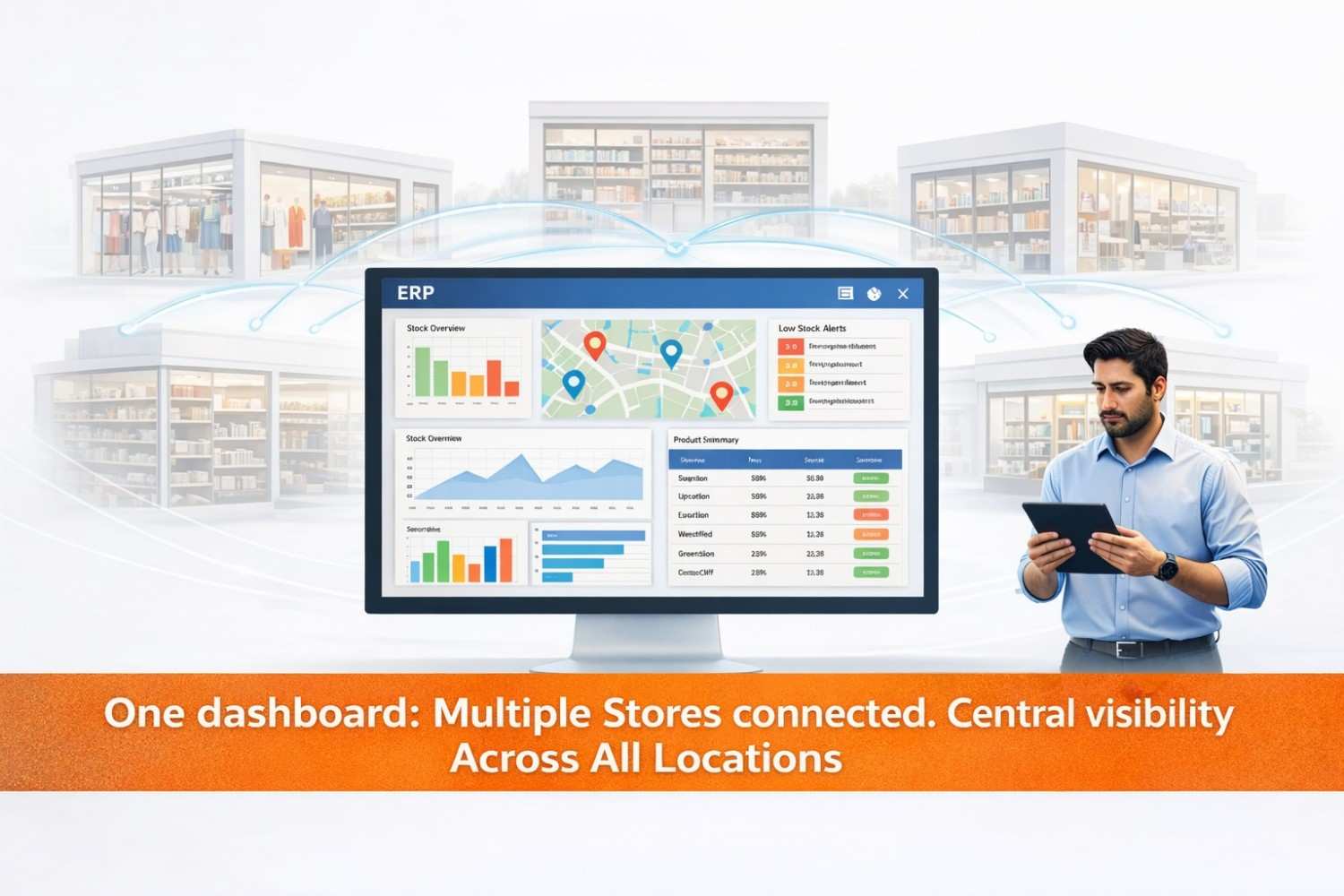
For multi-branch retailers and distributors, POSibolt supports centralized stock visibility across warehouses and stores.
Governance research further confirms that ERP projects benefit from multi-level oversight structures that reduce delays and rework through structured approvals. (Anees Ara & Al-Mudimigh 2011)
Stage 3: Execution and Real-Time Tracking
Timesheets / material consumption dashboard
During execution: Timesheets link directly to tasks, material consumption posts against the job, expenses reflect in budget dashboards, cost vs plan is visible immediately. Manufacturers benefit from BOM-driven production integration. Retailers benefit from synchronized stock updates across branches.
Instead of discovering losses after completion, management sees project health in real time.
Stage 4: Invoicing and Closeout
Cash flow discipline is essential in GCC markets. ERP enables: milestone-based invoice triggers, percentage-of-completion billing, retention tracking, project-wise P&L reports. Automation accelerates cash cycles while maintaining compliance.
At closeout: estimated vs actual comparison improves future quotes, margin analysis strengthens pricing strategy, data-driven learning reduces repeat mistakes.
Stop margin leakage. Start lifecycle control.
Discover how Hornet ERP connects quotation to completion in one platform.
Bahrain & GCC — tailored for SMEs
Key ERP Features That Enable Lifecycle Control
Modern ERP systems support real-world operational control: real-time dashboards, automated reorders, approval hierarchies, multi-branch visibility, mobile apps, integrated project-wise profitability.
- Inventory Tracking
- Project Dashboards
- Quotation Tools
- Expiry alerts, multi-store sync
- Store profitability visibility
- Promotion integration
- BOM, lot tracking
- Job cost variance
- Accurate material costing
Real-World Performance Impact
Implementation Without Disruption
Research consistently confirms that lack of structured project management is one of the leading causes of ERP underperformance. Implementation must follow a structured path:
Hornet’s approach focuses on: business-first consultation, customized configuration, controlled rollout, post-go-live support. For SMEs, typical timelines range from 3–6 months depending on scope. Cloud deployment reduces infrastructure burden and upfront cost.
When Should You Consider Lifecycle ERP?
- ▶ Multiple projects run simultaneously
- ▶ Inventory gaps delay execution
- ▶ Invoice cycles are inconsistent
- ▶ Profitability is unclear until month end
- ▶ Expansion across Bahrain or GCC is planned
- ▶ Management relies heavily on Excel for reporting
Growth without structure increases risk exposure.
FAQs
How does ERP reduce quotation errors?
Is ERP suitable for retail or manufacturing?
What about cost and timeline?
Conclusion
Project profitability does not depend only on winning contracts. It depends on controlling the lifecycle from quotation to completion.
Disconnected systems create: delays, overruns, margin erosion. Integrated ERP creates: structured governance, real-time visibility, faster billing, predictable profitability.
For growing project-based businesses in Bahrain and across the GCC, lifecycle ERP is not a technology upgrade. It is an operational control framework.
Ready to connect your quotation to completion?
Get a personalized demo for your SME. 3–6 month implementation, cloud or on‑premise.
+973 1717 8000 (Bahrain) – Serving GCC