Running a restaurant is no longer about great food alone – it’s about precision, timing, and control. Yet, many restaurants still juggle between multiple software systems for billing, inventory, payroll, and deliveries.
The result?
Slow communication, duplicated work, and inaccurate data : a recipe for chaos.
According to GreyOrange’s 2025 retail survey, over 63% of managers struggle with stock visibility, and one in four faces daily mismatches between physical and system data. For restaurants, such disconnects are even more costly. Every delay affects customer experience.
That’s where an integrated ERP and POS system changes the game.
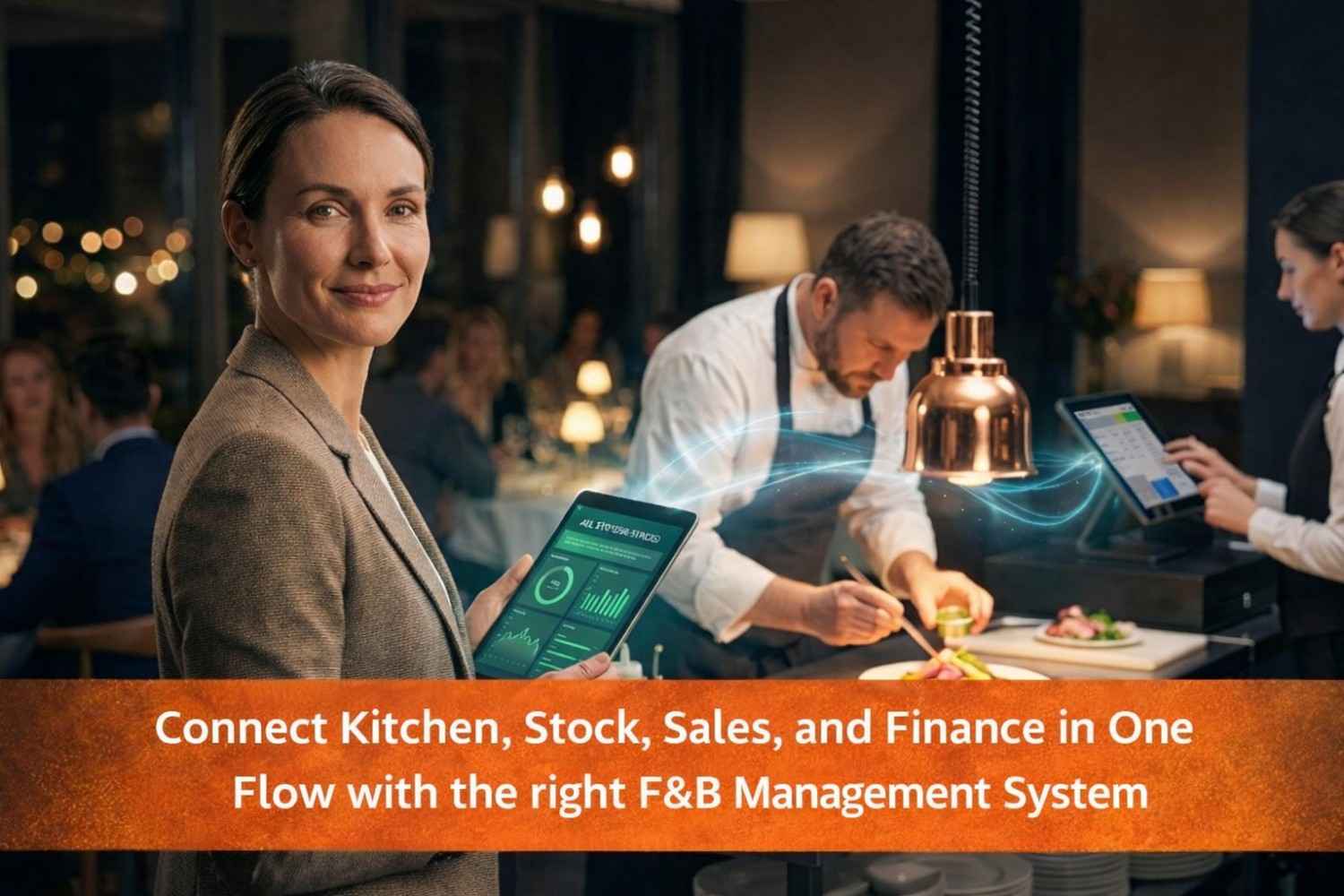
It brings your front-of-house (POS) and back-of-house (ERP) onto one real-time platform ensuring every order, ingredient, and expense moves in sync.
The Role of ERP in Restaurant Management
A Restaurant ERP (Enterprise Resource Planning) system is the backbone that connects your kitchen, finance, inventory, and HR in one place. Instead of running separate systems for accounting, recipe costing, and payroll, an ERP centralizes everything, automating data flow and minimizing human error.
Core Functions of Restaurant ERP:
- Inventory & Procurement:
Tracks stock in real time, sets reorder levels, and prevents over-ordering or wastage. - Recipe Management:
Calculates dish cost, portion size, and profit margins automatically. - Finance & Accounting:
Consolidates revenue, supplier bills, and tax compliance. - HR & Payroll:
Manages staff schedules, attendance, and payroll cycles. - Reporting & Analytics:
Delivers real-time dashboards on sales, cost, and profitability.
As Polaris ERP notes, restaurants using ERP systems have seen up to
20% lower food waste and 15% higher profitability
through recipe automation and predictive inventory control.
The Role of POS in Restaurant Operations
A Point of Sale (POS) system is your restaurant’s real-time operational engine.
From order taking to billing, POS manages every customer touchpoint.
Modern POS Highlights:
In 2025, POS is more than a billing counter, it’s the bridge that connects your guests to your kitchen and your kitchen to your ERP.
Why Unifying ERP and POS Systems is Essential?
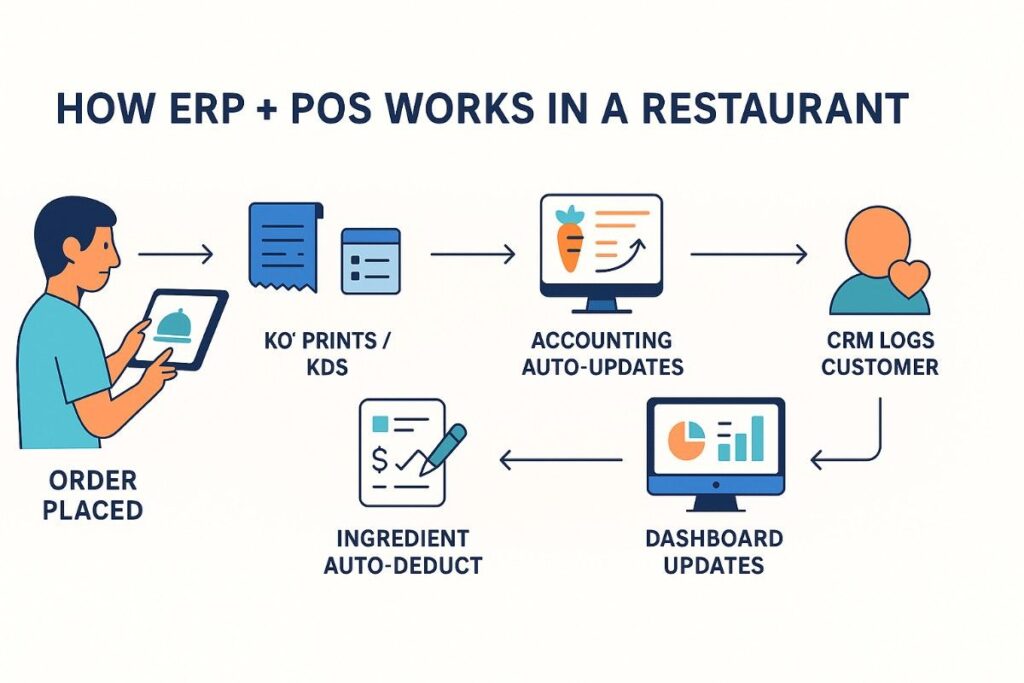
An integrated ERP + POS system creates a single source of truth. Data entered at any point, from order to invoice updates everywhere automatically.
-
Real-Time Data Synchronization
Every order placed at the POS instantly updates stock, accounting, and reports within ERP. No manual uploads, no mismatch.
→ Managers get a live view of sales, revenue, and inventory.
-
Faster Order-to-Kitchen Flow
Integration eliminates delays between order taking and kitchen printing. With live KOT and Kitchen Display Systems (KDS), chefs start preparing immediately.
→ Service speed increases by up to 30%, improving table turnover.
-
Smarter Inventory & Procurement
Ingredient usage auto-deducts per KOT. When inventory hits the threshold, ERP generates reorder alerts or purchase requests, avoiding both overstock and stockouts.
-
Streamlined Accounting
Each transaction automatically reflects in the accounting ledger. You can generate daily sales, expense, and tax reports with zero manual data entry.
→ Reduces reconciliation time by up to 60%
(RiseHQ, 2024).
-
Centralized Multi-Outlet Control
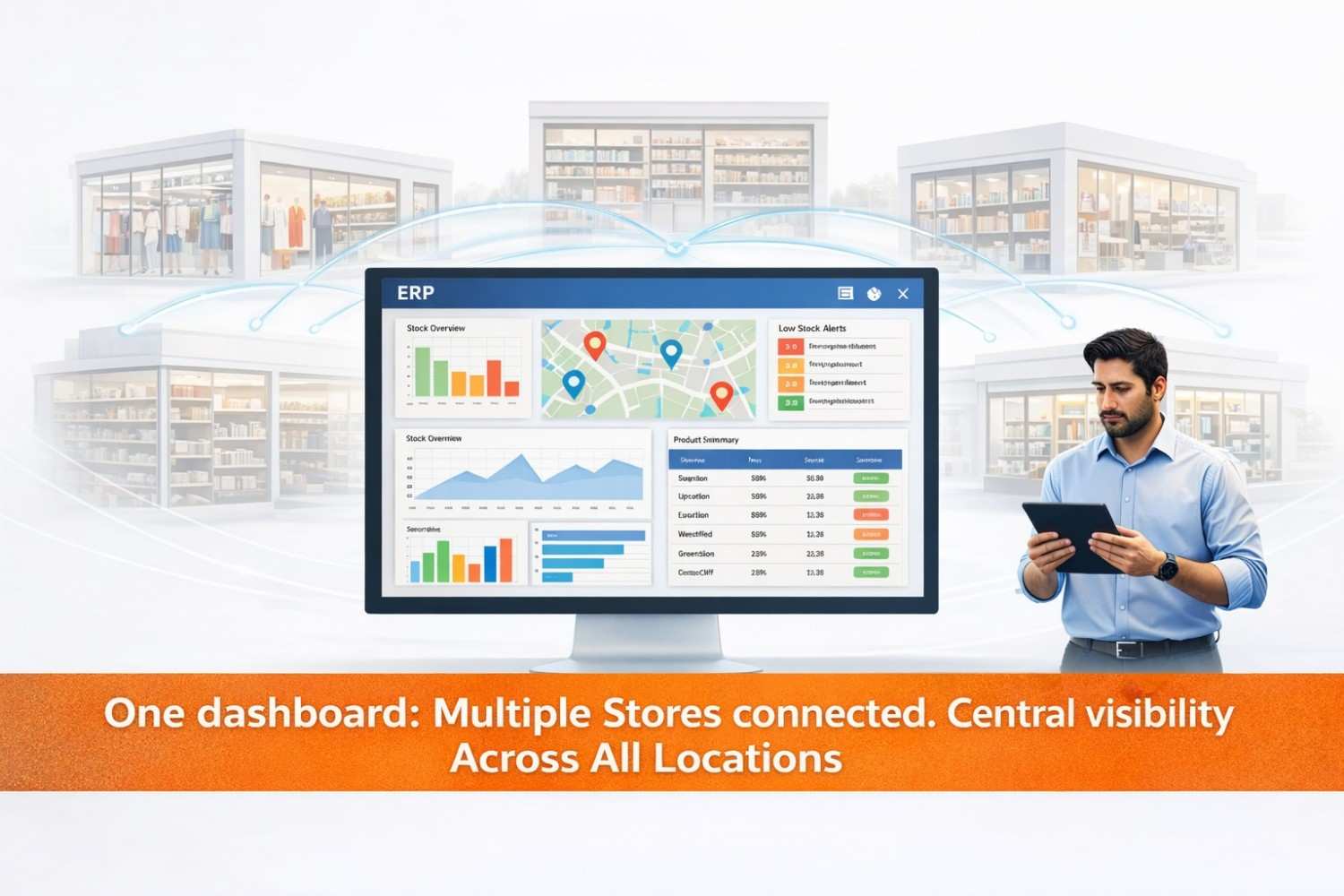
For restaurant chains or franchises, ERP + POS integration allows you to manage all locations from one dashboard — menu updates, pricing, and promotions sync instantly.
-
Enhanced CRM & Loyalty
Sales data merges with customer profiles.
→ Targeted campaigns, WhatsApp promotions, and loyalty points become automated and measurable.
-
Cloud-Based Access
Monitor operations anytime, anywhere. Owners and franchise heads can track performance across outlets in real time — a must for scaling chains in GCC markets.
Key Benefits for Restaurant Businesses
| Operational Area |
Traditional Setup |
With Integrated ERP-POS |
| Order Management |
Manual or paper-based KOTs |
Instant digital KOT & live kitchen sync |
| Inventory |
Delayed stock updates |
Real-time deduction & alerts |
| Accounting |
Manual entry & mismatched data |
Automated journal posting |
| CRM & Loyalty |
Scattered customer info |
Unified customer database |
| Reporting |
Static, weekly reports |
Real-time dashboards & insights |
Outcome: Faster service, reduced wastage, and higher profitability.
Features to Look For in the Right Restaurant Management System
When choosing a restaurant management system, look for features designed for food businesses, not generic ERPs.
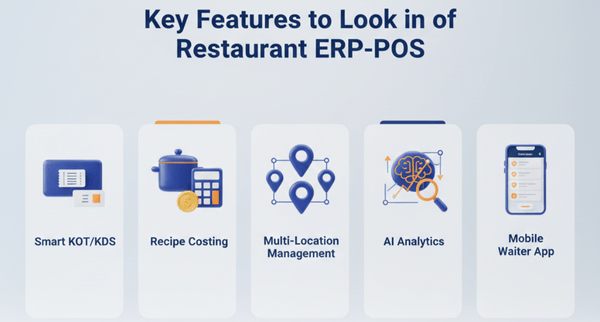
- Unified POS Module – Works on terminals, tablets, or mobile; connects seamlessly to ERP backend.
- Smart KOT/KDS Integration – Eliminates order delays and kitchen confusion.
- Inventory & Recipe Automation – Tracks raw material consumption per dish.
- Aggregator Integrations – Syncs with Swiggy, Talabat, Zomato, or online ordering apps.
- Multi-Location Management – Centralized control for branches and franchises.
- Data Security – PCI-DSS compliant, with encrypted transactions and audit logs.
- AI-Driven Reports – Predicts demand, tracks top-selling dishes, and suggests menu pricing.
- Customizable Dashboards – For owners, finance teams, and kitchen managers alike.
Common Implementation Challenges - and How to Avoid Them
Even the best software needs the right rollout strategy.
Typical Hurdles:
- Data migration from old systems.
- Staff resistance to new tech.
- Integration delays between POS hardware and ERP backend.
Solutions:
- Begin with a phased rollout — pilot one outlet first.
- Provide hands-on training and role-based user guides.
- Choose a vendor offering onsite + remote support and custom integrations.
Unified platforms cut training time by 40%, since staff learn one system for both front- and back-office use.
The Future of Integrated ERP in the Restaurant Industry
The next era of restaurant management is AI-powered and predictive.
- AI & Machine Learning: Forecast demand and adjust inventory and staffing dynamically.
- IoT Sensors: Monitor fridge temperatures, fuel levels, and waste in real time.
- Blockchain Traceability: Verify ingredient origin and quality for compliance.
- Analytics Dashboards: Offer 360-degree visibility into outlet performance, delivery time, and menu efficiency.
As per
Polaris ERP’s 2025 report
,
restaurants adopting AI-powered ERP saw
20% lower wastage and
15% faster order fulfillment.
How Hornet Technologies Leads This Transformation
At Hornet Technologies, we’ve built a platform that brings ERP and POS together — not as two tools, but as one unified ecosystem.
From DotOrders mobile waiter app to intelligent KOT and AI-driven dashboards, Hornet’s
Restaurant ERP-POS covers every corner of your operations:
- ✔ Unified Operations: Dine-in, takeaway, delivery, or QSR — all in one dashboard.
- ✔ Real-Time Kitchen Sync: Live KOT updates to kitchen displays and printers.
- ✔ Smart Inventory: Auto-deduct ingredients, trigger purchase requests, and control costs.
- ✔ Accounting Integration: End-to-end control of revenue, taxes, and P&L.
- ✔ BI Dashboards: View top-selling dishes, peak hours, and staff performance.
- ✔ CRM & Loyalty Tools: Engage repeat customers through personalized promotions.
- ✔ Cloud + On-Premise Deployment: Flexible options for restaurants of every size.
From single cafés to multi-brand restaurant groups, Hornet Technologies helps businesses
cut manual effort, gain real-time visibility, and boost operational efficiency across Bahrain and the GCC.
Who Benefits Most from Hornet’s Integrated ERP-POS
- Quick-Service Restaurants (QSRs): Faster checkout, reduced kitchen bottlenecks.
- Casual Dining Chains: Consistent recipes and centralized menu control.
- Cloud Kitchens: Real-time order aggregation and smart stock deduction.
- Fine Dining: Digital menus, table management, and loyalty tracking.
- Cafés & Bakeries: Portion costing, waste tracking, and integrated accounting.
Wherever food meets efficiency, Hornet fits.
In a business where every second and every plate counts, fragmented systems slow you down.
An integrated ERP-POS system brings structure, visibility, and speed — helping restaurant owners make decisions in real time, cut costs, and scale with confidence.
With Hornet Technologies, you don’t just get software — you get a partner in digital transformation.
From KOT integration to AI-driven analytics, Hornet’s Restaurant Management System empowers you to run operations the smart way — unified, simplified, and scalable.
FAQs